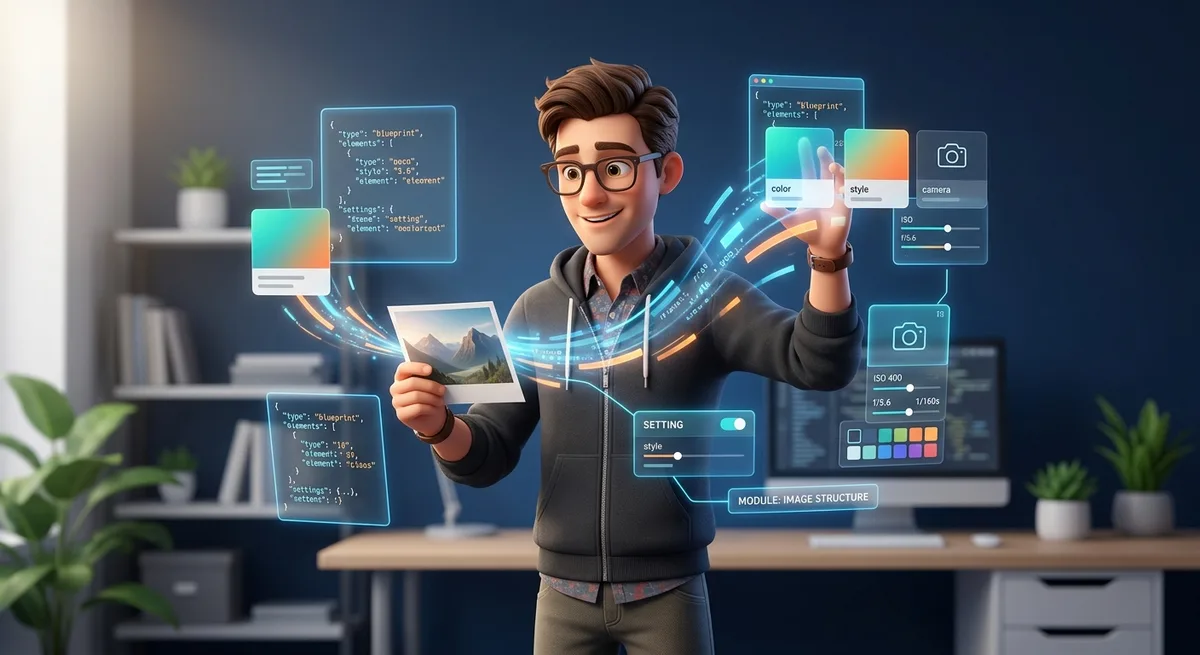
You’ve found an image with thoughtful lighting, colors and composition. You try to recreate the mood with a prompt, but the next generation looks different. A JSON file can’t recover the original creation process. A finished image doesn’t reveal all the settings or decisions behind it.
What can help is turning the visible qualities of a legitimate reference into a reusable art-direction brief. That makes your future attempts more consistent and easier to review.
In brief: Image-capable AI can describe framing, lighting, materials and approximate colors. JSON organizes those observations, but it isn’t a universal format accepted by every image generator and cannot promise an exact recreation. Use authorized references and compare results before selling the method as a service.
What you can observe versus infer
A photograph tells you where objects are and how shadows appear. It does not reliably reveal the camera lens, rendering parameters or original prompt. A model may estimate those details, but an estimate is not recovered metadata.
Even HEX colors derived by AI are approximate unless measured against the actual pixels with appropriate color handling. In this context, “visual reverse engineering” means structured visual analysis, not recovering a mathematically exact recipe.
For an independent business, the value may be making marketing graphics, product illustrations and campaigns more coherent.
JSON is a working brief, not a universal API
{
  "subject": "fictional product on a neutral background",
  "composition": "centered object, open space on right",
  "lighting": "soft light from left",
  "palette": ["muted green", "warm white", "light gray"],
  "materials": ["matte paper", "translucent glass"],
  "avoid": ["unreadable text", "extra objects"],
  "notes": "inferred visual description, not original camera metadata"
}
This is an illustrative schema of our own, not a documented request body for an image-generation API. Some tools accept plain text, while others use provider-specific fields. Adapt the brief to your actual model and its documented parameters.
A useful analysis request is:
Analyze only the visible elements of this reference image that I am authorized to use. Separate objective observations from inferences. Describe composition, apparent perspective, lighting, shadows, materials and approximate color palette. Create a simple JSON brief and identify any details that cannot be inferred reliably. Do not invent a camera, brand or original generation method.
A business application that stays honest
Imagine a small maker selling five handmade products. They want consistent lighting and backgrounds across campaign images, without copying the original reference exactly. A reusable style brief may help them coordinate new illustrations with a designer or generator.
But artistic similarity is not automatic permission to reproduce protected characters, trademarks or another person’s work. Review licenses, image rights and the generated outputs before commercial use.
This article has no benchmark demonstrating two-minute extraction, precise style cloning or sales of style packs.
A no-code first test
- Pick a photo you own or may legally use.
- Write down five visible qualities: placement, colors, light direction, background and negative space.
- Ask an image-capable tool to describe the reference and label uncertainty.
- Adapt the resulting JSON into a prompt supported by your chosen generator.
- If you have authorized access and budget, generate three variants and compare their consistency.
- Save the prompt, outcomes, license information and changes between versions.
Without an image generator, you can still compare the descriptions and create the brief. Don’t incur paid usage simply to complete an arbitrary tutorial.
The Solo verdict
Our straight take: is it worth your time?
Use a structured style brief when your real problem is consistency between assets. Don’t treat it as a way to reconstruct protected works or discover invisible camera settings.
A credible visual-direction service needs reviewed outputs, rights checks and practical iteration—not only a JSON document.
The workbench: from concept to an actual integration
The old example used a fictional https://api.modelo.com/vision endpoint and an undefined imageGen.generate function. Those were non-executable placeholders, not tested integration code. For a real implementation, select a provider, follow its current API docs, keep credentials out of source control and verify limits and rights.
The workflow is authorized image → visual analysis → human review → JSON brief → model-specific prompt → generation → quality review. Don’t automate bulk generation or publication without inspecting the results.
All outcomes described are proposed checks, not measured performance.
The practical advantage isn’t cloning every aesthetic. It’s making visual decisions explicit and reusable.
Documentation: OpenAI image and vision guide; Unsplash license; Wikimedia Commons. Review date: November 21, 2026.