Reference guide — created November 22, 2026. Model names, available voices and requirements evolve. These are contextual examples for this date; check current model cards and licences before deployment.
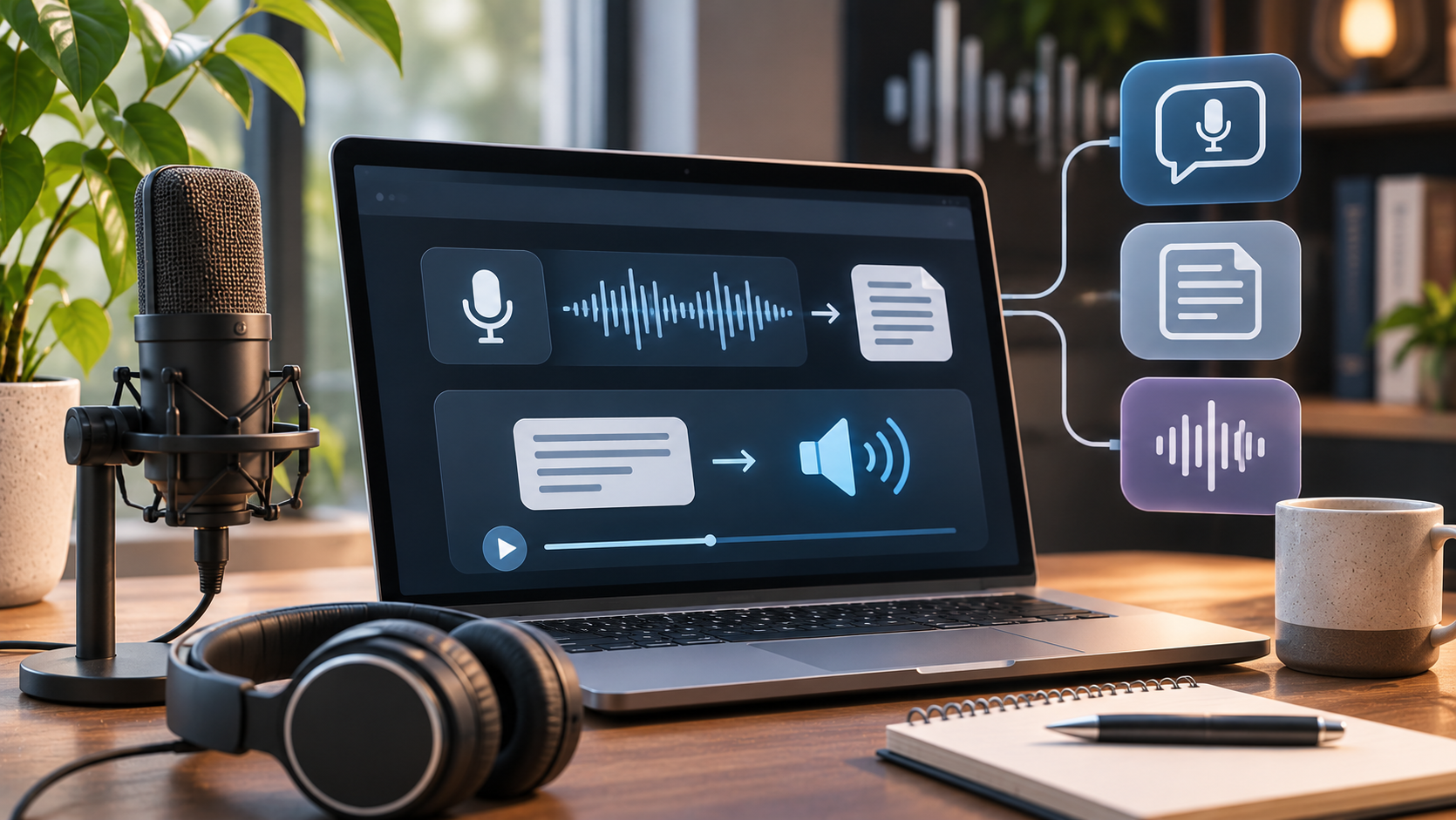
TL;DR: Audio AI involves distinct tasks. ASR recognises spoken words and produces text; TTS synthesises speech from text. Whisper provides speech-recognition models, faster-whisper is an alternative inference implementation, and Kokoro is a speech-synthesis example. Choose using language, accent, noise, speed, fidelity and use permissions.
01 — The discovery: audio is not one task
A solo business receives customer voice messages and wants searchable text. Another creator needs narration for a tutorial. Both may search for “AI audio”, yet one needs speech-to-text and the other text-to-speech.
ASR, automatic speech recognition, generates transcripts from speech. TTS, text-to-speech, generates speech from text. Other jobs include diarization (identifying speakers), voice activity detection, speech translation, noise reduction and audio classification. No model should be assumed to cover all of them.
Useful reference options
| Goal | Reference | What to evaluate |
|---|
| Multilingual transcription | Whisper and large-v3-turbo | Languages, accents, noise, memory, errors |
| Alternative Whisper runtime | faster-whisper | CPU/GPU, quantization, speed and compatibility |
| Speech synthesis | Kokoro-82M | Voice languages, pronunciation, naturalness, licences |
faster-whisper is not a completely separate model family. It uses CTranslate2 to run compatible Whisper variants. Comparing runtimes requires controlling for weights, audio input and decoding parameters. Project documentation.
The Kokoro voice inventory includes Brazilian Portuguese voices, but variety and quality differ across languages. Listen and check the exact voice terms before selecting one for your brand.
How audio systems are evaluated
For ASR, WER (word error rate) counts substitutions, deletions and insertions relative to a reference transcript. Lower usually means fewer word errors. Punctuation handling, accent, technical vocabulary and normalization affect scores. A single misheard amount or customer name may matter more than an impressive average.
TTS evaluation looks at intelligibility, pronunciation of names and numbers, pacing, naturalness and suitability for the project. Human listening tests are subjective and depend on sampling and protocol. A curated demo is not a complete production evaluation.
Privacy and voice rights
Local processing can keep audio within a controlled environment, but surrounding tools may still make network requests. Review consent, retention and storage before processing customer calls.
Do not clone or impersonate real voices without appropriate permission. Use legitimately licensed voice assets and communicate the synthetic nature of audio when appropriate.
02 — The Solo verdict
Our straight take: is it worth your time?
For meetings, interviews and customer messages, start with consented recordings and check names, dates and prices. For explainer video narration, assess voices using vocabulary and numbers from your own subject area.
Transcribing, narrating and interpreting customer intent are different tasks. A second model or manual review may be required after ASR.
03 — The workbench: transcribe a practice recording
Requirements: an owned or authorised audio file, compatible Python, FFmpeg and room for model downloads. Use an isolated environment and read Whisper’s installation notes.
python -m pip install -U openai-whisper
With sample.wav in a practice folder, a documented CLI pattern is:
whisper sample.wav --model turbo --language English
The first run may download weights. Review the resulting transcript for words, numbers and names; output paths and formats depend on CLI options. Compare smaller variants or faster-whisper if resources are limited.
Second exercise — TTS: visit the Kokoro model card and voice list. Select an appropriate, permitted voice and synthesize one example sentence through the documented method. Check usage rights and pronunciation before publication.
Next: learn how models turn document images into searchable text and structured data.