







Technology snapshot: November 22, 2026. The underlying ideas of training, evaluation and model selection tend to last longer. Named models, versions, libraries, licences, pricing and hardware requirements must be rechecked when you use them. This trail does not automatically update rankings.
Who this trail is for
You have heard that a model has billions of parameters, leads a benchmark or should run entirely on your own computer. But what does that mean when you want to build a product, automate repetitive work, process documents or create media?
This trail helps you ask the right questions before downloading model weights or paying for an API. No model-training background is required. Examples focus on actual solo-business tasks such as categorising requests, transcribing audio, reading documents and prototyping video.
Rather than a short-lived list of winners, the goal is a selection method that remains helpful as the model catalogue changes.
How the journey is organised
The ten lessons form three stages:
1. Learn the language of AI — steps 1 to 4. Understand training and weights, why AI is measured in tokens, the history of Transformers and attention, then navigate Hugging Face to inspect model cards, files, revisions and licences.
2. Evaluate before installing — steps 5 to 7. Interpret benchmarks, latency, memory and cost; run a small local model using Ollama and explore where a Small Language Model may be sufficient.
3. Match the model to the modality — steps 8 to 10. Examine video, audio and OCR. Each has distinct tasks, metrics, runtime constraints and risks.
What you will take away
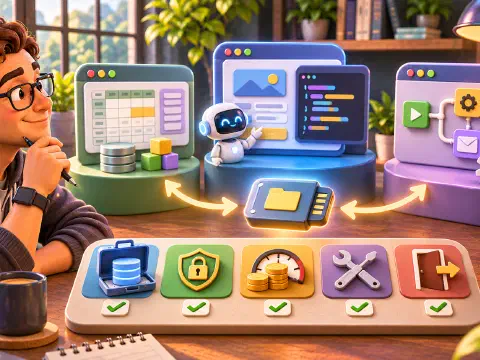
By the end, you can distinguish tokens, weights, Transformer architectures and runtimes, explain attention and context usage in accessible terms, locate a model repository, inspect licences and requirements, question a leaderboard and design a small evaluation for your own task. You will also know when a compact model, a hosted system or a non-generative software library may be a better choice.
Suggested approach: keep one real use case in mind. Before installing anything, note the purpose, input, expected output, language, test samples, available hardware, licence and success criteria. Compare the result with your current process, not just a leaderboard score.
Update rule: model recommendations are contextual examples as of this guide’s creation date. When version or licence matters, consult the official model card and the current revision before deployment.